Pilipino
 September 19, 2026

mag-iwan ng mensahe
Kung interesado ka sa aming mga produkto at gustong malaman ang higit pang mga detalye, mangyaring mag-iwan ng mensahe dito, sasagutin ka namin sa lalong madaling panahon.


Flake ice is added to concrete at the batching stage to lower the placing temperature before the mix leaves the plant. Typical addition rates are 30–70 kg per cubic meter of concrete, producing a mix temperature reduction of 6–11°C depending on ambient conditions, aggregate temperature and target discharge temperature. One critical rule: melted ice must be counted as part of total mixing water, or the water-cement ratio shifts and strength is affected.
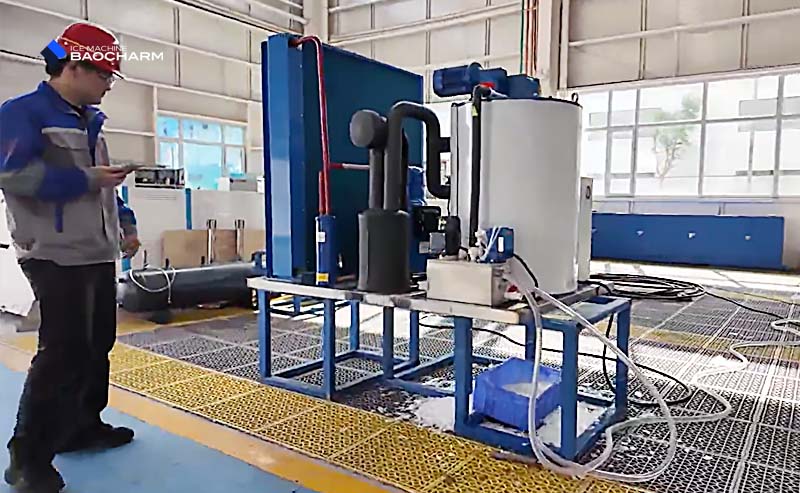
Cement hydration releases heat as concrete cures. In a thick, large-volume pour, internal temperature can climb to 60–80°C while the surface cools faster. That temperature gradient creates differential shrinkage and internal stress, which can lead to thermal cracking. Cooling at the mixing stage lowers the initial placing temperature before the concrete leaves the plant, reducing the gradient that develops during curing.
Chilled water and flake ice are both used for this purpose. Chilled water cools mixing water to roughly 2–5°C and can reduce concrete temperature by 3–5°C. Flake ice delivers deeper cooling because it absorbs latent heat as it melts, producing a temperature reduction of 6–11°C — the range needed for hot-weather pours or strict specifications. Many batching plants use both: chilled water as a base layer and flake ice for deeper temperature control.
The addition rate depends on three variables: ambient temperature, aggregate starting temperature and target discharge temperature. A commonly cited range is 30–70 kg per cubic meter of concrete. A simpler planning figure is sometimes used: roughly 7.5–10 kg of flake ice per cubic meter for each 1°C of temperature reduction, although the exact coefficient depends on mix proportions and ice temperature.
| Ambient / aggregate condition | Ice addition (kg/m³) | Estimated temperature drop (°C) | Note |
| Moderate ambient; aggregate near ambient | 30–45 | Toward the lower end of 6–11°C | Confirm with mix design |
| Hot ambient; warm aggregate 45–70 | 45–70 | Toward the upper end of 6–11°C | Confirm with trial batch |
| Strict discharge temperature spec | Project-specific | Determined by trial | Ice and chilled water may be combined |
Typical estimation under stated conditions; confirm with mix design and site data. Ice temperature, aggregate moisture and batching sequence all affect actual temperature drop.
Flake ice melts during mixing. The meltwater becomes part of the concrete’s total water content. If the mix design is not adjusted, the added water effectively increases the water-cement ratio, which reduces strength and can affect durability.
The adjustment is straightforward in principle: for every kilogram of ice added, the corresponding mass of mixing water is reduced by approximately the same amount. In practice, the batching system must be set up to make this deduction accurately, and the mix design should be reviewed by the concrete technologist before the first pour.
| Ice added (kg/m³) | Equivalent water (kg) | Water reduction required | Check point |
| 30 | ~30 | Reduce mixing water by the ice mass | Confirm batch computer setup |
| 50 | ~50 | Reduce mixing water by the ice mass | Check aggregate moisture |
| 70 | ~70 | Reduce mixing water by the ice mass | Trial batch recommended |
Ice is a water substitute, not an additive. The water-cement ratio must be maintained after the ice mass is deducted from the mixing water.
A concrete cooling system includes more than the ice machine. Flake ice at −8 to −5°C is stored in an insulated bin sized to hold roughly one-third to one-half of daily production, with a rake system to prevent bridging. A screw conveyor or similar delivery line feeds ice to the mixer, and a weighing hopper meters the ice charge.
The storage and delivery design matters because concrete batching is a timed process. Ice that cannot be delivered at the required rate will slow the batch cycle even if the machine’s daily capacity is adequate. The system should be sized from the peak batching rate, not from average daily consumption.
The flake ice machine for concrete cooling is a continuous-output machine; its selection follows the capacity logic in How to Calculate Flake Ice Machine Daily Capacity: Standard Conditions, Summer Correction and Sizing Margin and the ice-type logic in Flake Ice Machine vs Block Ice Machine: Which Ice Type Fits Industrial Cooling and Preservation?. Product reference: Full Automatic Ice Plant System 30-Ton Flake Ice Making Machine for Concrete Cooling.
How much flake ice is needed to cool concrete?
A common range is 30–70 kg per cubic meter of concrete, producing a temperature reduction of roughly 6–11°C. The exact rate depends on ambient temperature, aggregate starting temperature and the target discharge temperature. Trial batches are recommended for strict specifications.
Can flake ice replace part of the mixing water?
Yes. Melted ice becomes part of the total mixing water, so the mixing water must be reduced by approximately the ice mass. If this adjustment is not made, the water-cement ratio increases and strength can be affected.
How is mass concrete temperature control planned?
The plan starts from the target placing temperature, then calculates the ice addition rate from ambient and aggregate conditions. The batching system must be set up to deduct ice mass from mixing water, and storage and delivery must be sized to the peak batching rate. A trial batch confirms the actual temperature drop before production pours.
Use our concrete cooling estimation template. Send your target placing temperature, ambient and aggregate conditions, and batch size for an ice addition and mixing-water review. → Get the estimation template



Aming Mga Contact
Email: sales@baocharm.com
WhatsApp: +86 17663537579
Wechat: +86 17663537579
Mga Oras ng Trabaho: Lun ~ Sab 8:30 AM - 5:30 PM
 Sinusuportahan ang IPv6 network