Pilipino
 September 19, 2026

mag-iwan ng mensahe
Kung interesado ka sa aming mga produkto at gustong malaman ang higit pang mga detalye, mangyaring mag-iwan ng mensahe dito, sasagutin ka namin sa lalong madaling panahon.


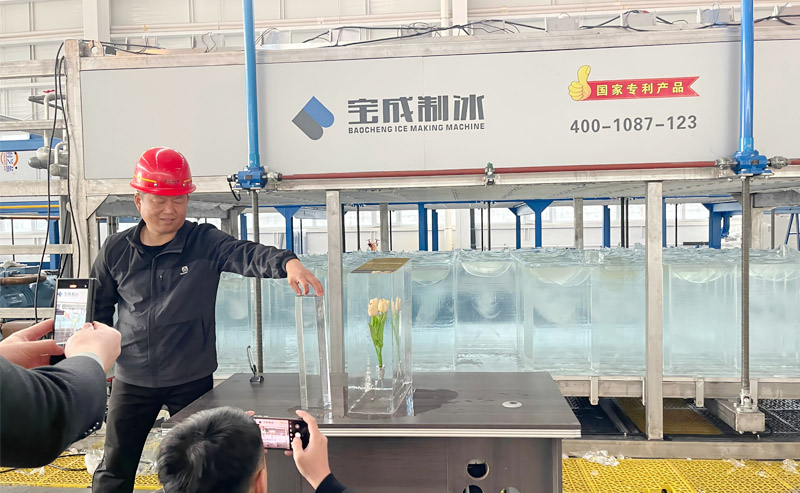
A cloudy block or white core means the freezing front moved faster than the bubble removal process, or the water carried more dissolved air and minerals than the process was set to handle. The usual causes are a shortened freezing cycle, reduced water flow, a change in water quality, or a combination of all three.
Figure 1: Cloudy block diagnosis path — freezing time, water flow, and water quality in that order.
Cracks after demolding usually come from stress introduced during freezing or release. The common causes are uneven freezing, a rough or incomplete defrost, and temperature shock after the block leaves the mold.
Cracks are a yield problem, not just a cosmetic one. A block that cracks cannot be used for sculpture or premium cutting, and the batch is effectively lost.
Figure 2: Demolding stress points — incomplete defrost, mold surface condition, and post-release temperature shock.
Blocks sticking to the mold point to a defrost problem, a mold surface problem, or a mold preparation problem. Sticking is not a normal condition and should be corrected before the next batch.
Bubbles concentrated in one area of the block usually indicate an uneven flow pattern or an uneven freezing front, rather than a general water quality problem.
Localized bubbles differ from uniform cloudiness. A uniform cloudiness points to freezing speed or water quality. A localized concentration points to the flow path or the freezing geometry.
Inconsistent transparency between batches means one of the process inputs is varying. The most common sources are water quality changes, filter condition, ambient temperature swings, and drift in the freezing cycle settings.
Consistency is what a distributor needs, and inconsistency is often harder to diagnose than a single bad batch.
The daily checklist covers the water source, the mold surface, the defrost sequence, and the visual result of each batch. The weekly checklist covers the filter condition, the refrigerant circuit inspection, the flow path, and the mold surface condition in more detail.
| Frequency | Check | What to look for |
| Every batch | Visual result | No white core, no bubbles, no cracks; same standard for center-hole blocks |
| Daily | Water source and filter | No change in source; filter not due for replacement |
| Daily | Defrost sequence | Complete defrost; blocks release cleanly |
| Daily | Mold surface | No visible scale, residue, or damage |
| Weekly | Flow path | No obstruction; flow rate within specification |
| Weekly | Refrigerant circuit | Visual inspection; no signs of leak or abnormal operation |
| Weekly | Mold surface (detailed) | Scale, wear, or damage that affects release |
| Monthly | Freezing time and holding time | Within reference values for the block type |
| Quarterly | Water quality | Within the range assumed in the process design |
The checklist supplements the manufacturer's maintenance schedule. It is a process-control overlay: the items that most directly affect whether the next batch meets the transparency standard.
If a batch fails the visual standard and the daily checks do not identify the cause, send us the batch details, the freezing time, and the water source information. BAOCHARM will help trace the deviation against the process conditions for your configuration.
Q: Why did my clear ice suddenly turn cloudy?
A: The most common causes are a shortened freezing cycle, reduced water flow, or a change in water quality. Check the freezing time first, then the flow rate, then the water source and filter.
Q: Can cloudy ice be fixed without changing the machine?
A: In most cases, yes. Cloudiness is usually a process deviation rather than a machine defect. Restoring the freezing time, flow rate, and water quality to the design conditions typically restores transparency.
Q: Why do my blocks crack after demolding?
A: Cracks usually come from incomplete or uneven defrost, a worn or scaled mold surface, or temperature shock after release.
Q: How often should the mold surface be inspected?
A: Visually every batch, with a detailed inspection on the weekly schedule.
Q: Does water quality matter more for clear ice than for standard block ice?
A: Yes. Clear ice production relies on the flowing water to carry impurities away, so a change in water quality directly affects the transparency.
Q: What refrigerant and compressor does BAOCHARM use?
A: Bitzer standard; Refcomp and Hanbell optional; R404A and R507 supported.
The final question is whether the supplier has stated the specification clearly enough to verify — batch capacity, freezing time, holding time, block type, component brands, and a transparency standard that can be checked. The inquiry and evaluation checklist is covered next.
If you are troubleshooting a clear ice batch and want to trace the deviation against the process conditions, send us the batch details, block type, and freezing time. BAOCHARM will respond with the likely cause and the adjustment to check first.



Aming Mga Contact
Email: sales@baocharm.com
WhatsApp: +86 17663537579
Wechat: +86 17663537579
Mga Oras ng Trabaho: Lun ~ Sab 8:30 AM - 5:30 PM
 Sinusuportahan ang IPv6 network